Showing posts with label MMO. Show all posts

Tuesday, September 26, 2023

Game Companies: Don't do Micro-Expansions, instead do shareable DLC!

The Evolution of DLC:
From Traditional to Shareable

Introduction

To begin, let us understand what a micro-expansion, aka micro-DLC, actually is. Micro-expansions are a subcategory of micro-transactions. In many cases, a micro-expansion, much like a larger game expansion or DLC, asks that every person buys it to gain access to it. This can include a wide variety of game aspects, such as dungeons, battlegrounds, areas or zones, and even other typical micro-transaction staples such as characters, classes and aesthetics.

The issues with micro-expansions are similar to the issues with micro-transactions when looked through the lens of what social damage it does to players in a game. This includes pay-to-win concerns from players who cannot participate in the dungeon to get loot from it, and therefore it is similar to a loot-box in the resulting benefits for the person who bought it. It fragments the player base, meaning less people can potentially play together. It becomes what the game design leans into, so that money can be excised from the player base instead of earned. All of these leads to upset players, who may stop playing because they cannot find the fun in the game anymore.

Which is where my proposal comes in: If you sell DLC for single access dungeons, then allow the person who bought it so share that access with anyone in their group. It gives access to the content to people who cannot afford to buy the DLC, and yes for some people even that $2.99 can be too much, and it helps with the problem of fragmenting player bases. If you have a free vs monthly/battle pass model, you can even give one free dungeon to those who buy a battle pass, and that way those in guilds could cover all the seasonal content by working together on what free dungeon they pick.

The Problem with Traditional DLCs

So why did companies leave making traditional DLCs, large patches of content that often times feels like a sequel within the same game engine. The player base often looked forward to such expansions every two to three years. People would renew accounts, start preparing for the expansion, and often play through the game quickly and drop their subscriptions again after a few months. Even though many players would continue to leave subscriptions on while not playing or even would actually continue to play after these rushes, the growing amount of players and the need to adjust to the size of the rushes meant that companies would have to invest in extra servers that they would end up no longer needing or would need to continue to operate after it was no longer profitable to their margins.

Producers have been seeking out how to diversify their monetization so that they do not have to be stuck in one model. Producers have pushed Developers to decrease the space between one expansion and the next, which begins asking players to pay for a new expansion every year.

There are benefits to faster smaller DLCs for developers as well. It helps keep player engagement up, since the space between DLCs is smaller, and therefore people who only play for new content stay subscribed longer. It has less risk of being wrong in a design choice, as in making a mistake in design did not waste multiple years development time and money, and is instead less impactful to the bottom-line.

This all leads to the current state of games, which are Battle Passes over the traditional monthly subscription. Battle Passes offer rewards over the top of the free to play model. They reward players coming back to the game daily, and therefore generate player engagement. They often allow you to earn in game currency or other rewards for playing and doing daily check ins. This model often sells other micro-transactions, but allow you to earn the next battle pass, or at least earn more value based on in game currency than normal in game currency purchases would.

This all leads to the new problem games are heading towards, which is, selling where you can play. Lands to explore, arenas to fight in, dungeons to delve, are all being sold piecemeal and are not being included in the purchase of the subscription or battle pass. These micro-DLCs are going to magnify the issue of traditional DLCs in that you will start to see hyperfragmentation of the player base. Leading to a point that someone could buy the DLC, and have no one to play it with.

My Proposal: One DLC for the Whole Party

The idea is simple: If you want to sell a dungeon individually to people, allow them to share it with their group. The idea behind this is similar to Dungeons and Dragons having a DM who usually has all the books and the players join and get to participate and use the book content without having to buy the book themselves. Most of the people who would take advantage of this would not have bought the DLC themselves, and the player gets to enjoy what they purchased without worrying that no one else bought the DLC. Because the benefits are higher for those who do spend the money, and the loss of monetization to the company is minimal, since most people taking advantage of this would not have made the purchase, there is little worry of missing out for the company.

You could even give out a free dungeon for taking up a battle pass or paying a subscription. That way with this model, players can coordinate with their guilds or friend group to cover their bases. It increases the desire for people who play in groups to join guilds or invite friends.

The issue of dungeons being glorified loot boxes can also be resolved this way. Usually selling a dungeon is like selling a loot box, but you have to play through it first. This allows a reason for players to want to run the dungeon with the player who bought it. Sharing the dungeon could also increase their drop rate of materials or non-equipment goals. It makes sharing worth it, and makes purchasing the DLC worth it as well.

Developers can target people who do not have the micro-DLC in other ways, to help build monetization. Playing in a shared dungeon can lead to earning points to purchasing the dungeon for free, and therefore cascade dungeon runs out across the population. As people earn the dungeon, the dungeon sharing rewards naturally decline, incentivizing recruitment of outside players, "Come on! You can play for free and I can share the dungeon with you!" as free advertising. Not to mention that such models are viewed so favorably with players that it fosters an extremely positive view of the company.

Actual Real World examples of not using Shareable Content DLC

One of the major content companies using shareable DLC is actually tabletop gaming. Even in a digital space, places like Roll20 ask only that one member of an adventure of the DLC to be able to share it with others for that adventure.

Companies focused on short term monetary gains over the life long monetization of their product are moving away from that into the realm of individual micro-transactions and micro-DLC. Wizards of the Coast and by extension Hasbro is looking to follow Blizzard into the hellpit of micro-DLC to nickle and dime every player out of money, despite making billions of dollars already, and having HAD one of the most profitable games in their respective market.

And the same way that Blizzard Activision has lost its ability to earn trust in their player base to the tune of being bought out by other companies and having their entire team disbanded for failure of the executives, so too does Wizards of the Coast have the specter of doom looming over their future business model.

Already evidence has shown that people left WoW for FF14, and people have migrated from D&D to Pathfinder, with 4 more major D&D-a-likes coming out that address the issues with the game, and have the promise of freedom of creation to 3rd party makers.

Conclusion

So often companies start off with passion about their games. They make games in service of gamers. In turn those gamers create huge buzz and talk about the game that it reaches the general zeitgeist. Gamers grow up and become content creators: artists, writers, directors, producers. They make content for people, which references these games in sacred terms, and popularizes them.

Then the companies abandon the gamers, and target the average consumer. The average consumer, not having time to game all day, loves the shortcuts and purchases they can make with real dollars to shortcut their advancement so they can enjoy the game. Which is exactly where micro-transactions have value to those casual gamers.

This abandons future gamers, people who would love that original game experience like their parents had had 15 years earlier, but who now cannot enter the game without micro-transactions. They abandon the game, and suddenly future revenue drops as the casual gamers pay-to-win themselves out of content and migrate to another game.

Mitigating that migration, requires treating your game as if people could leave it at any time. If you realize that you do not have perfect control of people's desire for your game, then you have to design it in a way that it engages them. Things that remove people's ability to engage, can be managed with sharing. You can strive for engagement with rewards for sharing, and create natural endings to it so that in the end, you have received enough engagement from all those participating in your game, and those who pay to play, have enough people to play with.
Tuesday, September 4, 2012

City of Heroes; dies

Unfortunate news comes out that NCsoft is closing down City of Heroes. The article says 80 employees will be affected. This is (according to the article) happening about a year after the game went free-to-play. I think its important to look at the fact that free-to-play is not some sort of balm you can apply to your game and have it become more popular or make more money.

The sad thing is, that City of Heroes/Villains, was not even considered a bad MMO! It wasn't excellent, but it wasn't a bad game. Their free to play model was interesting in that they had 3 tiers (free tier, one for if you had bought something before, and a VIP monthly membership).

Like Star Wars, end game in City of Heroes was only available to those who were VIP members. Other strange VIP only things were the ability to write in forums, creating super groups (if you were not middle tier you couldn't even join), the ability to talk in all channels (if you were a free tier you couldn't even whisper people, only local and team chat).

So here you have a game where the free model is nothing more than a trial that goes all the way to the end. Fine if you and your friends have communication outside of the game, and if you have no care about doing something at the end of the game.

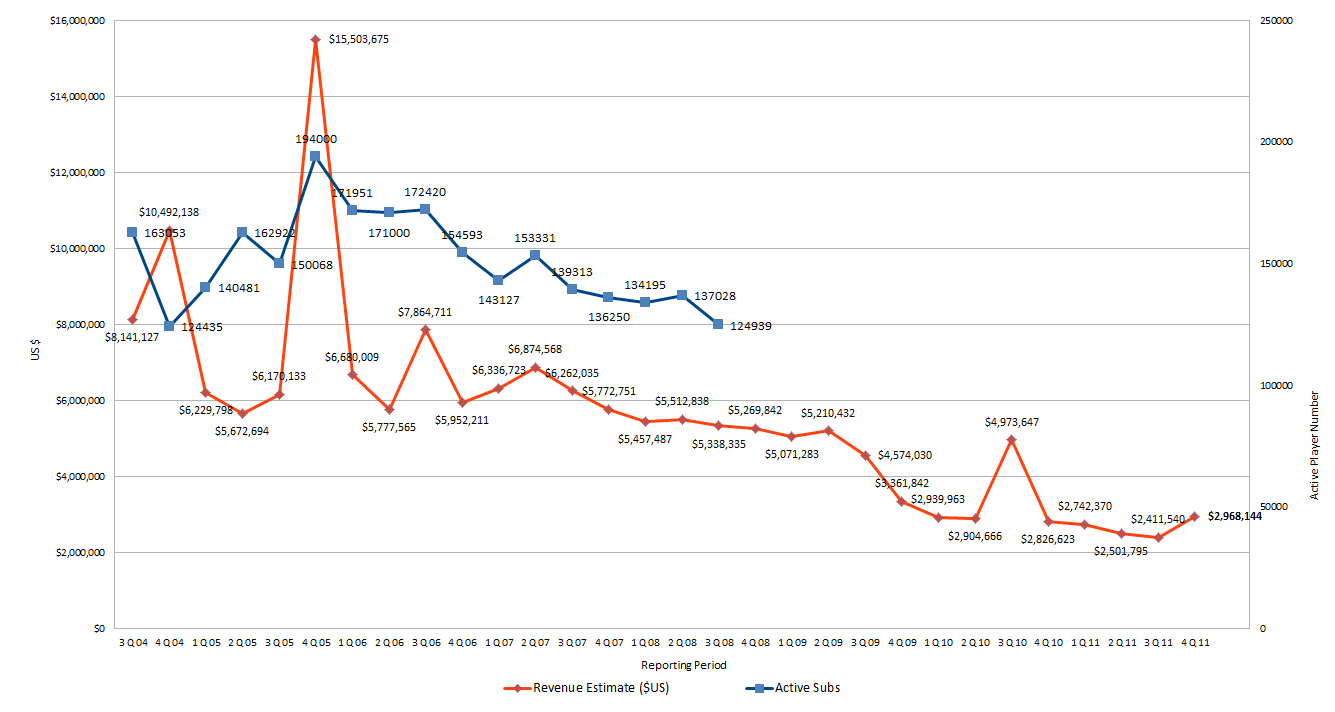
I think that it wasn't that they went free to play, or that they had a game that wasn't good enough. I'm not even sure about their population numbers or income. (...here...125k active subs in 3rd Q 2008, which meant bringing in $5.3million) What I do know is that executives didn't want it anymore, and that their free-to-play model was poorly executed. I found in the comments of the article linked on top of the page, that they were down to a couple of thousand active players (not sure if they were even VIP or not). I'm not sure of the accuracy of that number though.

With this in mind, keep an eye out for what SWTOR is actually going to be providing free-to-play members. It could be that giving more than they should (the whole story arc) is what makes people play the game and desire to spend money to raid etc.

I hope that all those affected by this land on their feet.

Sunday, April 22, 2012

SWTOR numbers going down, but Still Profitable

Though subscriber numbers are going down, SWTOR will soon surpass its sunk cost of $200 million by the end of May (if you believe that is the cost). If they are able to stay above 1 million subscribers by the end of the year, they will be in the black as far as server maintenance and continued development costs go.

The question is, will it be able to maintain a subscription model, or will they have to find a way to go free to play?

Monday, March 12, 2012

Using Scene Flow in Video Games

A good, well flowing story scene usually contains six steps (you can break this mold, just like everything else, but since we are using these six steps, bare with me): Goal, Conflict, Disaster, Reaction, Dilemma, Decision. The point of these is to clearly point the protagonist at something, watch them fail, then watch them do something about that failure.

In a well written story, that doing something amounts to a new goal in which they no go towards. Even if the disaster does not full impede them, it still prevents them from reaching the goal. An example of conflict that is resolved but does not lead to the goal, is Mario stomping on a goomba. Though it resolved the conflict of what was happening then, it does not exactly get him to the end of the level. The game doesn't end at that resolution.

In a story, you would see the hero stop the bad guy from killing someone, but the bad guy would get away. So lets go into each step as it relates to passive story telling mediums.
  1. Goal - The protagonist, or POV character in the scene (if you are doing a scene with the bad guy POV), wants something. This is what they are trying to accomplish in the scene
  2. Conflict - This is something that is preventing the goal from occurring. The POV character is being stopped by this conflict, either self, person or environment, etc.
  3. Disaster - This is the point where the character fails the goal. This should continue until they get to the end, at which point disaster is flipped. This does not equate to character death, but it should cause the current goal to no longer be viable.
  4. Reaction - This is where the story flips from being about external factors and focuses in on the POV character. What does the Disaster mean to them and their Goal?
  5. Dilemma - With the Goal no inaccessible, what are the choices presented to the POV character.
  6. Decision - This is where the POV character decides on a choice presented in the Dilemma. They should choose the least bad choice of what to do next (in a comedy they would choose the worst choice).
Now, I'll go through these and break them down in parts and moments of a game. Lets try Mario 64. Don't forget, it may not have every aspect of this, and some of it (especially, the last 3, tend to be internalized with the player).
  1. Goal - At the start of a level, Mario is presented with the goal, get to the star.
  2. Conflict - The environment and enemies are stopping Mario from getting to his goal. This is not a disaster yet, because the goal is still within reach.
  3. Disaster - This does not exist in the case of a Mario 64 level. It does occur though on the level of the player attempting to get through a portion of the level.
  4. Reaction - This is the player's feelings at failing to get through a challenge.
  5. Dilemma - These are the options that the player has after failing to reach the goal (in cases are catastrophic disasters, this may be restart from a previous save).
  6. Decision - Again this is usually put on the player, they decide to keep playing, try their new tactic, or quit.
A good game level, will allow for these six steps to repeat enough times before the character has failed enough to make the goal something to cheer about, but not so many times, that the goal ceases to be viable.

Breaking the steps in half, reveals that the first three steps tend to be external, while the final three steps tend to be internal. This is true in both scenes and in gameplay. Switching back and forth between these moments is what allows the consumer (movie goer, reader, gamer) to keep interested in the product.

Applying this into an MMO scene, we can see where people have issues with quests and missions in MMOs. A scene in this case will be the quest. The issue with quests is that the Disaster has occurred already. The actual event that is happening for the player is that someone else has reacted to the disaster, experienced a dilemma, and found that asking the player for help is the best decision.

All of the internal player stuff is being done by the NPC. The decision of what to do about something is out of the player's hand. They are not making a decision about how to solve the disaster, instead, they are living out an NPC's decision. The only control the player has is rejecting the decision, which means that no quest, therefore no scene occurs.

To change this, The Old Republic tried making the player part of the decision making process. This works sometimes (Commando quest where the guy asks to kill the pirate instead of rescuing him). At these moments, the game succeeds in fixing bad questing.

Yet this step is not without constant and ever present failures. Quite often the game's dialogue options lead to no changes at all in what is going to happen as far as the decision goes. The issue continues to be that the more choices that are presented to the player as valid for progressing their story (not the game's story, but the player character's story of adventuring), the more time and energy and resources that get lost, and eventually the smaller the game will feel (though each play through would allow for countless choices, how far you could follow them would continue to diminish due to how expansive the choices would have to be).

So how can games allow for players to make the decision on how to deal with a disaster? One way would be more ambiguous quest directions. That means, that instead of killing 8 boars, the quest should be to thin their numbers in the forest. Then provide different ways for the player to interact with the boars.

They could kill them, trap them and sell them to a farmer or lead them away. The key is to allow the player to experience those internal steps: Reaction, Dilemma and Decision.

Scene info taken from Randy Ingermanson's website.

Thursday, December 2, 2010

The Multi-game

The idea of multiple games affecting each other is something that EVE creators CCP are experimenting with in Dust 514. For a long time I had been thinking of a Mega Game. A game that was persistent and had everything in it. MMOs covered part of it, and FreeRealms kind of did what I wanted. I haven't tried Lego Universe yet, but it seems to have a nice variety of activity in it.

No, a Mega Game is about being all games tied to a single Avatar. You would make your Avatar, and control him in a persistent world. This world would have adventure and hi-jinks. With this same character, with the stats and choices you make, you can then switch over to racing, fighting, puzzle combat, crafting, etc etc. Your choices in appearance, and stats would affect the other aspects of the game. So high agility or intelligence would give you faster acceleration in the racing game or strength and intelligence would give you a better top speed. Your car would look a certain way based on your gear and appearance choices (details were never figured out).

The other idea I've been hoping to see (or later on create) is a true Multi-game. Where I could release a city building Sim to casual players, which in turn becomes cities used in a strategy game. The cities layout would be used for when a unit invades an occupied city. The game would then become a Tower Defense style game.

Tuesday, August 24, 2010

NWN - Without Roper

After two years, Chief Creative Officer, Bill Roper has left Cryptic to pursue something else (apparently to start a new company).

Now, for the past year, they've been working on Neverwinter Nights, and since they are starting to do interviews, I'm guessing that its starting to reach fulfillment. Now, Bill Roper was heavily involved with Champions Online, but he said he only barely touched on Star Trek Online. So how much involvement did he have with NWN, and if not enough, could that be why he left? Was he suddenly feeling stifled by it all?

Depending on how involved he was with this game, will decide for many people how much they feel they will like or dislike this game. Now, apparently I'm a big fun of Bill Roper (I may be the only one!?), so how sure can we be about the quality of this game? Who is involved?

So, I found an interview that Gamespot recently did with Jack Emmert (chief operating officer). Some points from the interview are as follows:

The game is not massively at all. It is simply an online multiplayer game. Imagine logging into (unmentionable MMO) and only using the Dungeon Finder. Some zones will be public, and some will be for teammates only. But not in the concept of a "hub world".

They are translating D&D4e rules into computer lingo, so, even though the starting classes are only five or so (fighter, wizard, rogue, ranger, cleric), we can expect that many can be showing up further down the line.

With how they break down the abilities, they translated D&D4e's, at-will, encounter, and daily powers into any-time, each encounter, and every few hours. This means that you would log in, play through a session, and log out for a few hours.

They are investing in including flanking, positioning, and tactics into the gameplay (not sure how it will be implemented, but in D&D4e, flanking makes it easier for you to hit).

The character editor, will be similar to CO and STO, and they will have Humans, Elves, Dwarves, and a few mysterious others (Drow, Eladrin, Warforged, Teifling, what? Honestly, being mysterious about this now is just stupid). It might mean that they are currently incomplete.

The storyline is tied into R.A. Salvatore stories (though not necessarily written by him). The adventures will occur within Neverwinter, and just outside of it, at least in the beginning. They have plans to expand after release. The game will take place 100 years in the future.

Players will be able to create stories, maps, and create quests for the map. Emmert specifically made the effort to point out that people will easily be able to tell they are using User Generated Content versus in-game content. So, that is almost a guarantee that "Forge" (their ingame creator) will be pretty lame.

It is set to be released in tandem with the R.A. Salvatore book, Gauntlegrym, which is being released October 5th, 2010.


Wednesday, July 14, 2010

Champions - More Fun than Before

Time is passing, and Champions Online is becoming more and more fun. Now, I still don't play as often as I'd like (with having to use my wife's computer and all, since it doesn't run will on Linux, and even if it did I'm down to only 1gb of RAM), and so my highest level toon is 18 (about to hit 19). One good thing about this experience, is that I got to try out the Serpent expansion zone on a low level hero.

Now to get to it, I had to talk to an UNTIL agent over by the Helicopter that takes you to the Desert and Canada. He gives you a mission to go visit UNTIL headquarters. Once there, I got the mission to go to the Jungle in Africa, and I went to a helicopter inside UNTIL HQ, and that took me to the new zone.

The first zone there is pretty small. I did a few steps of the mission, nothing out of the ordinary. I was pretty much by myself, since I imagine many people are higher level than me, or haven't figured out how to get there.

Aside from a  new zone to explore, the game is becoming more fun as I tweak the UI, and get accustomed to navigating the world. The AH has an icon on the map now (which I might have pointed out before), and searching for an item is easier.


My favorite thing is how an auction can stay in there indefinitely. Often times, I'll post several things and come back a couple of weeks later to find everything sold. When you log in, you get your money automatically, and you can even check your mail from the website, to know if you have money coming.


I like the website integration, in that I can mail someone from outside the game, and they get the message in the game.